Our process technology is characterised by customised, efficient concepts made up of tried-and-tested modules.
We offer customised automation solutions that are precisely tailored to customer requirements.
Our service, maintenance and training services are customised to your individual needs.
This is particularly advantageous when different processes need to be controlled one after the other in a cycle time-optimised manner. A robot also offers a high degree of flexibility in terms of the usability of the automation for other assemblies or products.
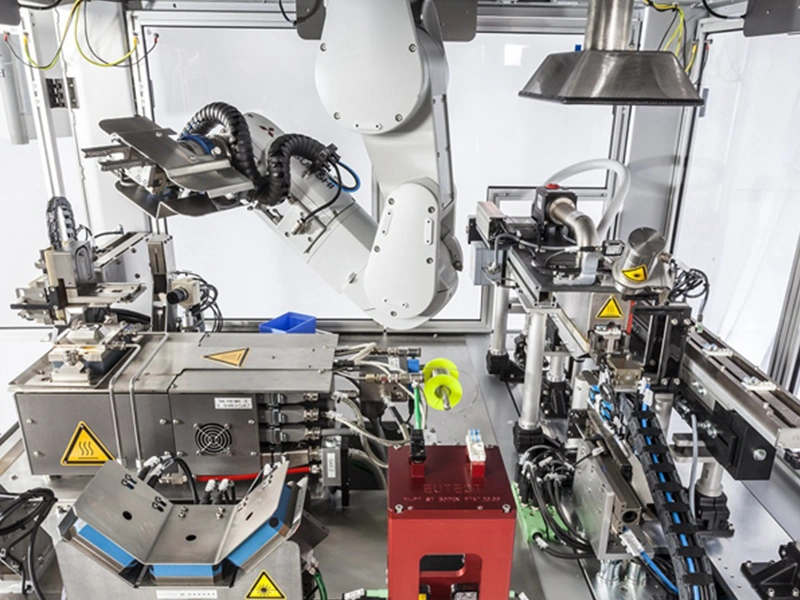
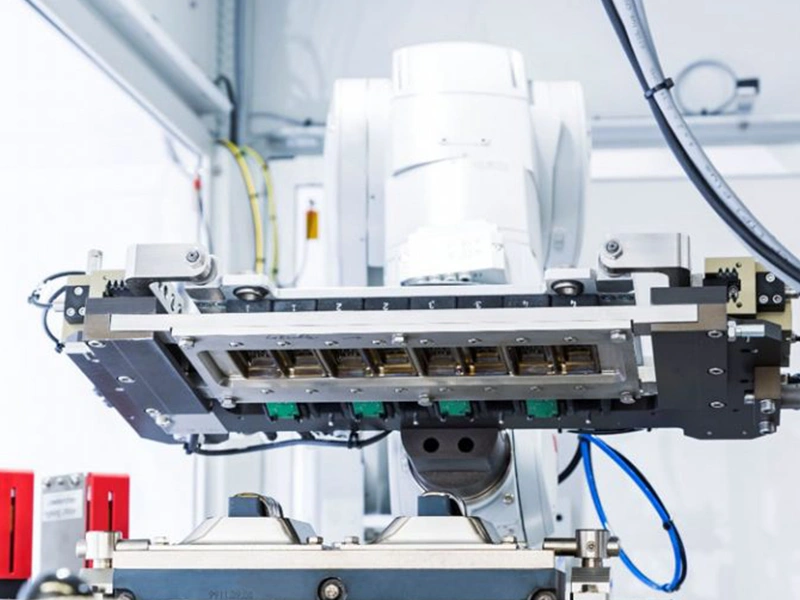
One of EUTECT's specialities is the integration of complex robot solutions. But the little brothers, the cobots, have also found their way into the EUTECT production cells. The integration of a robot makes it possible to utilise a wide variety of processes in a production cell. In some cases, up to five processes can be controlled with an overhead robot, depending on the size of the cell. By integrating soldering masks into the robot gripper, assemblies can be fixed during gripping and soldered overhead, e.g. using a mini wave. In the following video we present our capabilities in this area in detail.
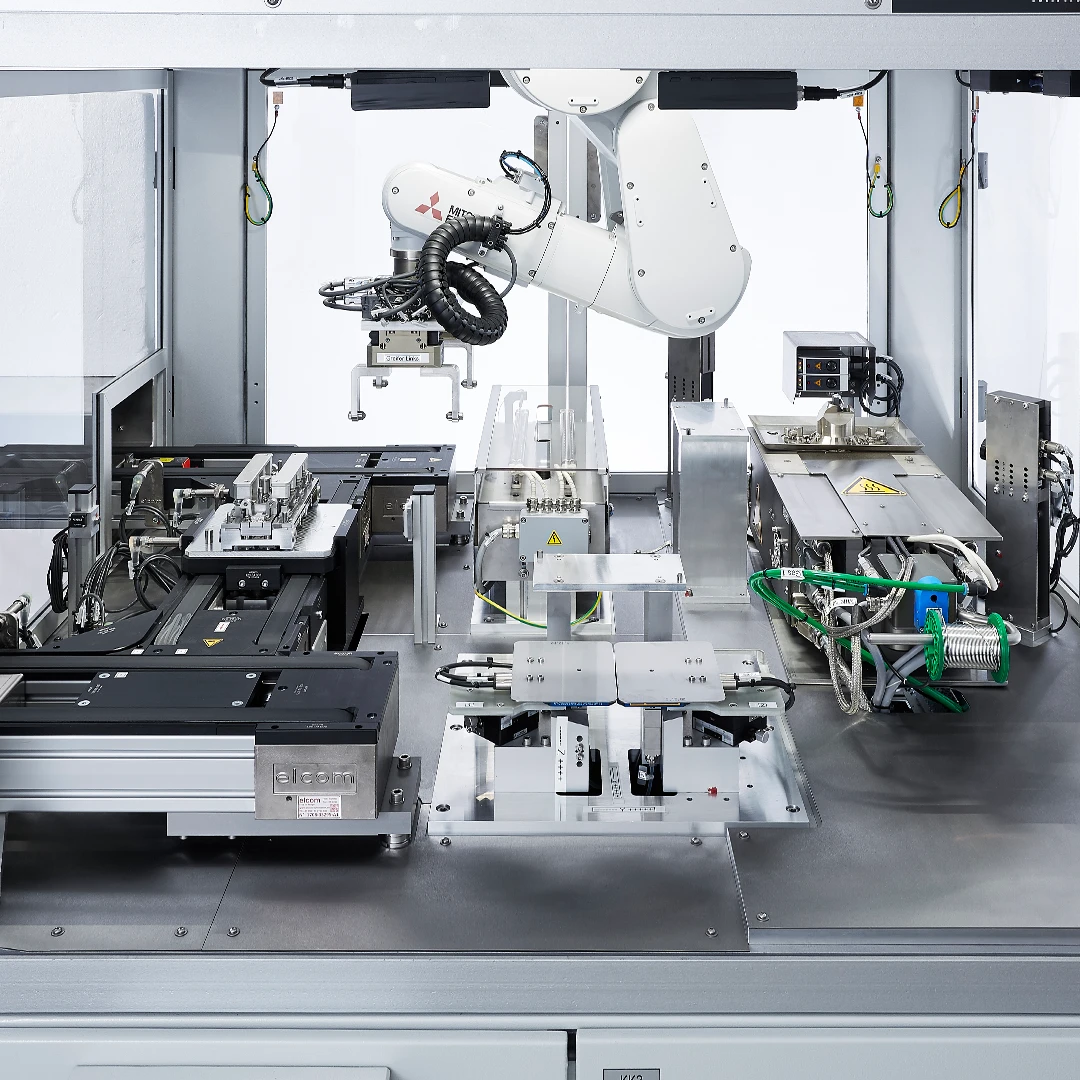
Robots enable flexible, precise and space-saving automation of selective Soldering processes. Thanks to their freedom of movement, assemblies and Workpiece carrier be moved between different processing stations within a process cell. This makes it possible to combine several processes within a small space and to process different assemblies flexibly.
In particular, EUTECT integrates 6-axis industrial robot in Customised production and soldering cells. Depending on the component, process, cycle time and automation requirements, the appropriate robotic solution is selected and integrated into the overall system.
Robot-assisted automation solutions EUTECT products can be used with various selective Soldering methods can be combined. These include, amongst others, Mini wave soldering, Laser soldering, Induction soldering, thermode soldering and Piston soldering. This allows the robotics and soldering process to be tailored individually to the specific assembly and application.
Yes. A key advantage robot-assisted process cells is the combination of several processing steps within a single plant. Depending on Cell size With EUTECT, up to five different processes can be controlled by an overhead robot.
6-axis robot They offer a high degree of freedom of movement and can guide assemblies precisely to process modules from a variety of angles and positions. This allows for flexible arrangement of the soldering, testing and machining stations, whilst also reducing the space required by the production line.
Yes. EUTECT can Solder masks directly into the Robot gripper integrate. This secures the assembly during gripping, allowing it to be fed into a mini-wave soldering process, for example, whilst suspended overhead.
Product-specific grippers are responsible for the safe handling and positioning of the assemblies. If grippers and Solder mask When combined, the assembly can remain securely fixed in a defined position throughout the handling process. This reduces the number of additional handling steps and enables complex process positions.
Yes. Robot-assisted soldering cells are particularly useful in production environments where different assemblies or product variants are manufactured. Motion sequences, process positions and machining steps can be programmed and adapted to suit the specific application.
Thanks to a robot’s great freedom of movement, process and inspection modules can be arranged compactly within a cell. An overhead robot installed It also makes use of the available installation space and can reach several stations. As a result, traditional transport and conveyor systems, amongst other things, can in some cases be dispensed with.
Depending on the application, you can conventional workpiece carriers and Transport systems be reduced or partially replaced. To this end, EUTECT develops, amongst other things, product-specific gripper and workpiece carrier solutions that are tailored to the respective assembly and the soldering process.
A robot-assisted solution This is particularly useful where a high degree of flexibility, different product variants, several consecutive processes or a compact machine footprint are required. Even in the case of complex motion sequences and frequently changing production requirements, robotics can offer advantages over rigid automation concepts.
Yes. In addition to soldering and machining processes, it is also possible to Test modules be integrated into an automated process cell. Thanks to the flexible positioning of the assembly, the robot can move to different process and inspection stations within the plant.
Robot-assisted systems may also be of interest for smaller batch sizes and a wide range of variants, as motion sequences and process programmes can be adapted to different products. Whether their use makes economic sense depends, amongst other things, on the product mix, cycle time, scope of the process and degree of automation.
In principle, different soldering and process modules can form part of a robot-assisted automation solution . The key factors are the existing processes, interfaces, component geometries and requirements regarding cycle time and quality. EUTECT develops bespoke system integrations for this purpose.
The design is based, amongst other things, on the assembly, solder joints, the desired soldering process, cycle time, product variants, the required testing processes and the available installation space. Based on this, Robotics, Gripper, Workpiece carrier, Process modules and plant layout to form a coordinated automation concept.