Technical realisation
When developing the best possible process technology for soldering tasks, we focus on the desired product quality, existing automation concepts in production and process quality.
By evaluating all solder joint properties, we find the most suitable soldering process for your task, taking into account cost-effectiveness, efficiency and the conditions and requirements in production. Together with us, you can use our soldering processes and automation expertise to develop the right process for your product and your production.
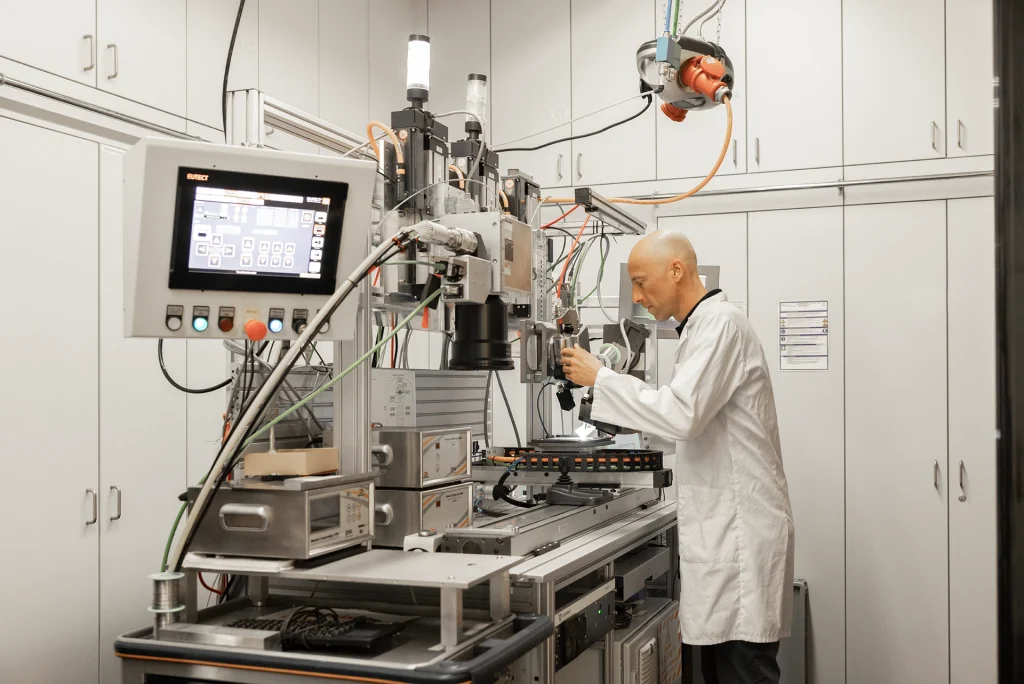
Our EUTECT technical centre is equipped with all soldering process modules from our range. Here we evaluate your and our processes in order to achieve the goals required by you or your customer or to make them even more efficient with newly developed solutions. This enables us to guarantee stable and efficient series production with the desired quality of results.
The benefits you gain from a joint evaluation
Growth in expertise
Increased expertise thanks to our many years of soldering process and automation experience in product design, metallurgy, software, processes, control and automation concepts
Cost-effectiveness
New process and automation solutions for economically optimised results
Feasibility
100% information on the feasibility of a desired solution
Product optimisation
Possible product changes for even more stable and efficient production and process solutions
Process documentation
Transparent evaluation and process documentation
Neutral rating
Metallurgical analyses with neutral assessments
System integration
Efficient complete systems or module integration through simultaneous engineering
Evaluation
Six building blocks.
An optimal soldering process.
Our services to find the right solution – from the very first solder joint to a fully defined process.
Evaluations
We will solder your assembly using the appropriate modules from the EUTECT product range.
Microscopic images
Independent institutes inspect your solder joints and assess their quality.
Evaluation reports
Evaluation results – presented clearly and explained in a way that is easy to understand.
Process discovery
We analyse which processes will deliver the best possible outcome for your requirements.
Feasibility studies
We assess the soldering options for your assembly and identify any necessary product modifications to improve efficiency and ensure that objectives are met.
Process definition
We define your future process, taking the economic framework into account.
FAQs
What is meant by the evaluation of a soldering process?
In the Evaluation of a soldering process An assessment is carried out to determine which soldering process is best suited to a specific assembly, solder joint and production requirement. Factors taken into account include product quality, process reliability, suitability for automation, cost-effectiveness and the requirements of subsequent series production.
Why should a soldering process be evaluated prior to mass production?
Early Evaluation helps to identify technical and commercial risks even before mass production begins. Various Soldering methods, process parameters and Automation concepts can be tested and compared with one another. This makes it possible to develop a stable and reproducible process for subsequent mass production.
Which soldering processes can be evaluated at EUTECT?
At the EUTECT Technical Centre, the focus is on Soldering process modules from the EUTECT portfolio. This enables different methods and process concepts to be investigated using real customer components, and the most suitable solution for the specific soldering task to be identified.
How does EUTECT carry out an evaluation of a soldering process?
The starting point is the assembly, together with the customer’s technical and economic requirements. Suitable soldering processes are then selected and trials are carried out using the relevant process modules. The results are analysed and documented. This can lead to the development of a process definition and recommendations for the subsequent production and automation solution.
Can our own components or assemblies be used for the evaluation?
Yes. Customer assemblies can be manufactured at the EUTECT Technical Centre using various Soldering processes be processed. This makes it possible to assess feasibility under real-world conditions and to tailor the soldering process specifically to the product in question.
What factors are taken into account when selecting the appropriate soldering process?
In addition to the properties of the solder joint, factors such as the desired product and process quality, existing or planned automation, production requirements, as well as cost-effectiveness and efficiency are taken into account. The aim is not only to achieve a technically sound solder joint, but also to establish an overall process that is suitable for subsequent production.
Can an evaluation determine whether a soldering task can be automated?
Yes. The Evaluation can take into account not only the actual soldering technique but also the future automation concept. This enables process and automation solutions to be coordinated with one another right from the development stage.
What is a feasibility study in soldering?
A Feasibility study examines whether a specific soldering task can be carried out technically and economically, and by which method. In doing so, it can also identify any necessary modifications to the product or assembly that would contribute to greater process stability or efficiency.
How is the quality of solder joints assessed during an evaluation?
The solder joints produced can be analysed and assessed, for example, using micrographs. EUTECT also refers to testing carried out by independent institutes in this context. This enables the results of the process trials to be objectively assessed and documented.
What does an evaluation report contain?
The evaluation report documents and explains the Results of the experiments carried out. This provides the customer with a clear basis for further process development and for defining the future production process.
Can the evaluation also highlight changes to the product design?
Yes. As part of the Evaluation This makes it possible to identify potential product modifications that could make a soldering process more stable, more efficient or easier to automate. In this way, the evaluation can contribute to ‘design for manufacturing’ as early as the initial stages of development.
Is an evaluation still worthwhile if the subsequent soldering process has not yet been finalised?
It is precisely then that a Evaluation sensible. Different process approaches can be investigated using the specific assembly before a final decision is made on soldering methods, process parameters and automation.
Can samples and small batches also be produced at the EUTECT Technical Centre?
Yes. The technical centre can, in addition to Evaluations also for Prototype soldering, small-batch soldering and C-sample production be utilised. This enables insights gained from process development to be further refined under conditions close to those of actual production.
What are the benefits of developing the soldering process and automation in tandem?
By considering the soldering process, the product and automation together, interfaces and potential limitations can be identified at an early stage. This supports the development of a solution that not only achieves the required soldering quality, but can also be designed for volume production in terms of cycle time, process stability and cost-effectiveness.
At what stage should EUTECT be incorporated into product development?
Involvement at the earliest possible stage is particularly beneficial when solderability, process selection or automation have not yet been definitively defined. In this way, insights from soldering technology, metallurgy, product design, software and automation can be incorporated into the development of the assembly and the subsequent manufacturing process at an early stage. EUTECT explicitly identifies this transfer of expertise as an integral part of the joint Evaluation.
Table of Contents


Sales management
Enquiry
Like the majority of our customers, you can also use our technical centre for sample soldering, small series soldering or C-sample production. Simply get in touch with us.