Laser soldering

Automated laser soldering
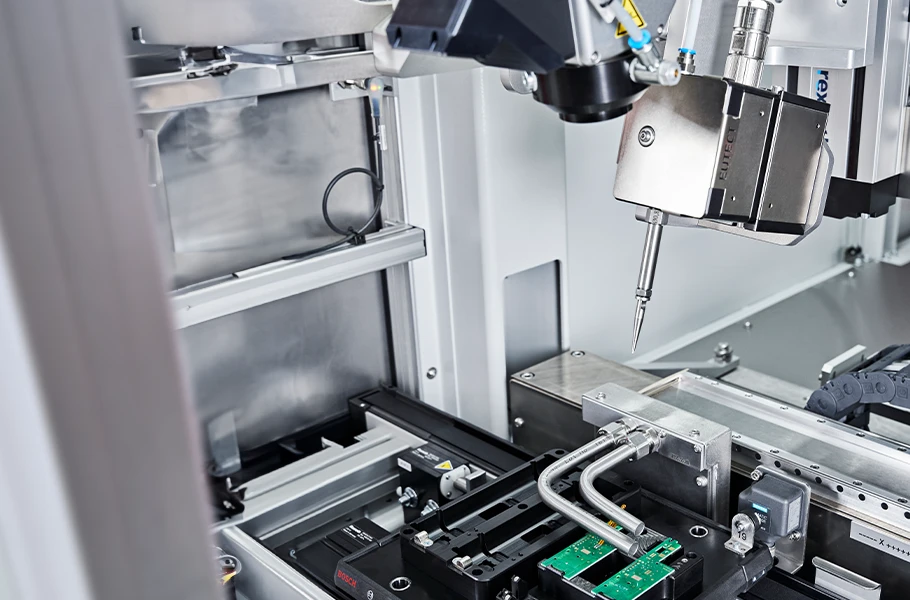
EUTECT laser soldering ranges from single beam to galvo optics with 25 to 1,500 watts of power.

Benefit

Soldering using EUTECT laser soldering technology is unique!

By using a pyrometer for controlled laser power input, the laser power is adjusted to the previously entered temperature after the 10,000/sec measured temperature on the surface to be processed.

Performance

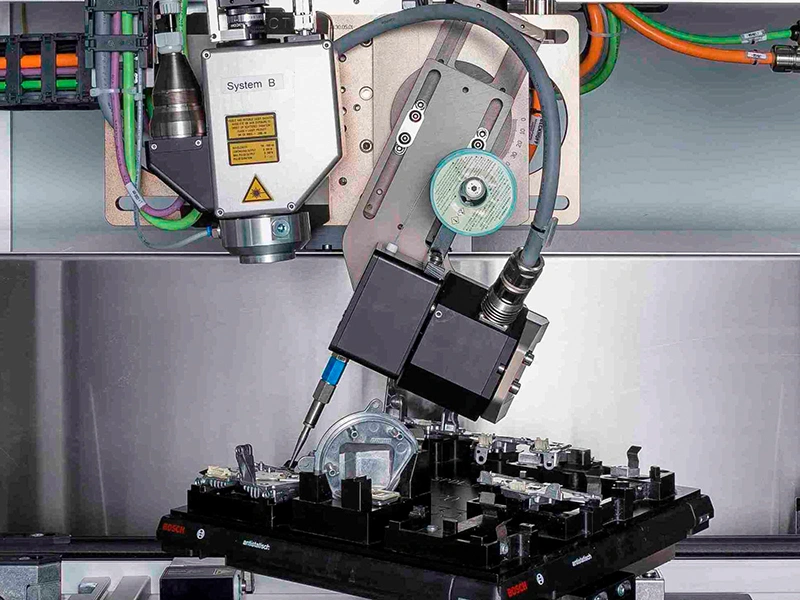
The controlled laser technology is combined with the SWF wire feed module patented by EUTECT, the world's only force-, path- and speed-controlled wire feed, which can recognise wire that is deviating or not fed correctly thanks to force detection and measurement. The laser, pyrometer and camera are centrally mirrored in the coaxial optics and equipped with integrated position and focus visualisation as well as automatic IO/NIO video memory. The diode laser system, which is manufactured in a clean room, is air-cooled and offers maximum energy efficiency and service life.

Modularity

The interplay between the controlled laser power input and the force- and path-controlled wire feed provides a 100% closed-loop laser soldering process.

Product highlights

  • 100% Closed Loop
  • Regulated wire feed (SWF)
  • Integrated high-speed pyrometer control
  • EUTECT Recording Inspection Camera (ERICa)
  • 100% traceability
  • Freely definable energy input
  • Simple and intuitive parameterisation
  • Non-contact energy input
  • Immediate system and process availability
  • Maximum energy efficiency
  • Minimized solder consumption
  • Minimal need for spare parts
  • Low maintenance effort
  • High flexibility
  • Short set-up times
  • Minimal footprint
  • Maximum service life
  • Minimised service costs
  • 25 to 1,500 watt diode laser
  • Air Knife

EUTECT's innovative strength in laser soldering

EUTECT has established itself as a leading supplier in the field of laser soldering through continuous innovation and technological advances. One key to this success is the patented Sensitive Wire Feeder (SWF). This system recognises and corrects wire feeding errors in real time. This drastically reduces production errors. At the same time, a highly accurate quantity of solder is precisely supplied. This technology ensures that soldering processes run smoothly and is therefore invaluable in automated production environments.

Another innovative step from EUTECT is the pyrometer-controlled laser power. The versatile system makes it possible to create both lead-free and lead-containing solder joints with high precision.
How laser soldering works

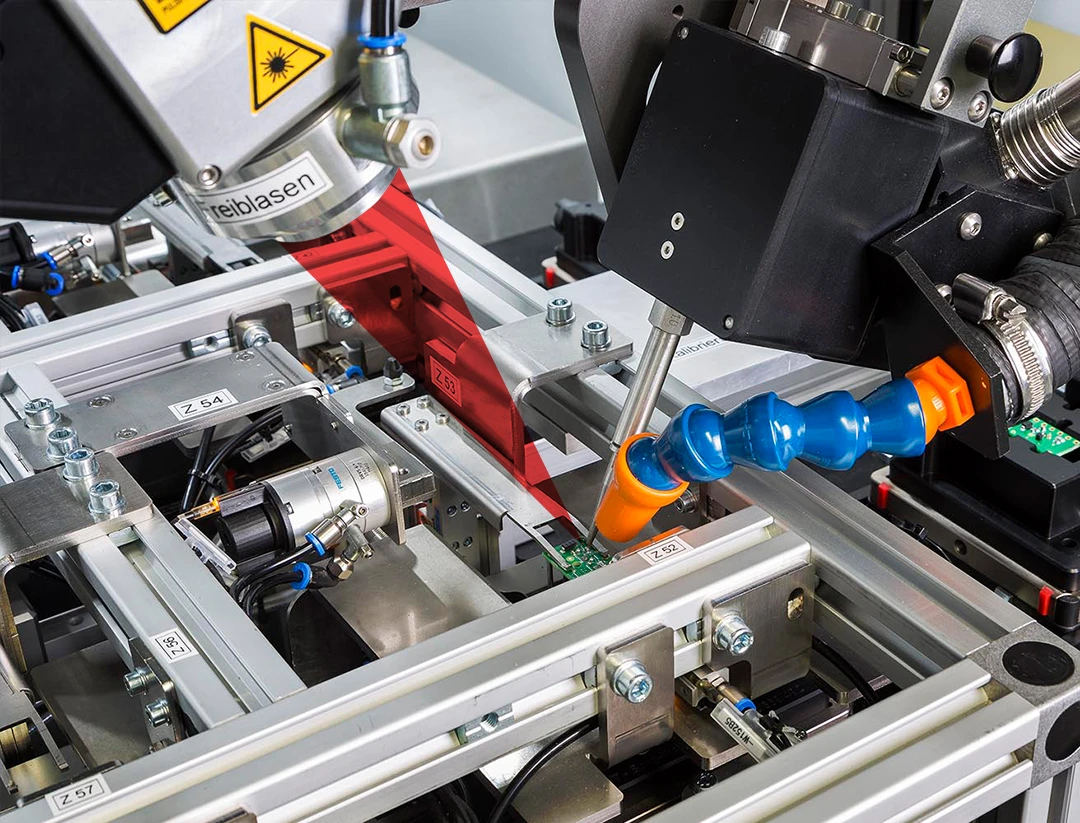
Laser soldering uses a highly focussed laser beam to generate the exact soldering temperature required at the soldering point. The laser beam is precisely focussed on the solder joint, resulting in fast and controlled heating. An outstanding feature of the EUTECT laser soldering process is an integrated pyrometer. This continuously monitors the predetermined temperature on the soldering surface, allowing the laser power to be precisely controlled at a frequency of 10 herz. As a result, the soldering temperature remains exactly within the parameterised range. For example, the laser power is adapted to the absorption behaviour of the laser, which in turn significantly minimises the risk of burns at the soldering point.

Advantages of laser soldering

Laser soldering offers several significant advantages compared to conventional soldering methods. Firstly, this technology is extremely energy-efficient, as the laser beam is focussed exclusively on the area to be soldered. This reduces the amount of energy required. At the same time, the thermal load on the surrounding material is minimised. The structure of the component thus remains unchanged. These are particularly important advantages in the electronics industry, where sensitive components are often located very close together.

Another advantage is the non-contact mode of operation. As this method does not involve any physical contact with the soldering point, mechanical influences that could potentially lead to damage with other soldering techniques are avoided. The non-contact process also enables a high level of reproducibility to be achieved, which is essential for automated production processes in particular.

Product video

FAQs

Laser soldering enables precise, non-contact and locally confined heat input. This makes the process particularly suitable for temperature-sensitive components, high packing densities and hard-to-reach solder joints. Further advantages include high reproducibility, short process times, low maintenance requirements and good integration into automated production lines.

Laser soldering It is particularly suitable for selective soldering tasks where heat needs to be applied in a highly targeted manner. Typical applications can be found in electronics manufacturing, for example with sensitive electronic components, sensors, connectors and complex assemblies with limited installation space.

As the laser energy can be precisely focused on the actual process site, the thermal stress on the surrounding areas is reduced. In contrast to processes in which larger areas of an assembly are heated, the heat input during the Laser soldering limit it locally.

At the EUTECT laser soldering The temperature at the process site is measured using a high-speed pyrometer. Based on the measured temperature, the laser power is controlled and adjusted to suit the specific process. This allows, for example, for differences in the absorption behaviour or thermal properties of the materials being joined to be taken into account.

‘Closed loop’ means that key process parameters are not merely set in advance, but are monitored and controlled throughout the soldering process. At EUTECT, the controlled laser power and the controlled wire feed combined with one another. This creates a closed-loop control system that ensures the process stability and reproducibility of the Laser brazing process supported.

The patented Sensitive Wire Feeder (SWF) EUTECT’s system enables force-, travel- and speed-controlled feeding of the solder wire. The force-sensing function allows, amongst other things, deviations in the wire feed to be detected. This enables the required amount of solder to be fed in a reproducible manner and increases process reliability.

With EUTECT laser brazing, various process parameters can be monitored and documented. These include, amongst others, the temperature profile, laser power and wire feed rate. In addition, the EUTECT Recording Inspection Camera (ERICa) as well as the Solder Guard can be used for visual process monitoring and documentation.

Yes. Data relevant to the process can be recorded and linked to the respective solder joint or the finished product. This enables the Laser soldering process can be documented in automated manufacturing environments and used to meet traceability requirements. EUTECT explicitly cites 100 % traceability as a product feature of its laser brazing process.

At the Galvo laser brazing The laser beam is directed to different process positions using rapidly moving mirrors. This means that the assembly or laser module needs to be moved less between individual solder joints. This can reduce process and cycle times, particularly where there are several solder joints spread out across the workpiece. EUTECT offers galvo scanners for this purpose as part of its laser brazing technology.

A Galvo scanner This is particularly useful when several solder joints within a defined working area need to be processed in quick succession. As the laser beam is moved optically between the positions, mechanical travel movements can be reduced, thereby enabling shorter cycle times.

The laser power required depends on the specific application, the materials, the geometry and the thermal masses of the parts to be joined. EUTECT offers laser solutions ranging from single-beam to galvo optics, using diode lasers with power outputs from 25 to 1,500 watts.

Yes. That EUTECT laser brazing process It can be used for both lead-free and leaded solder joints. It is essential that the process parameters are tailored to the solder alloy, the components being joined and the assembly.

The solder flow can be influenced, amongst other things, by ensuring the components to be joined are adequately preheated, by correctly positioning the laser focus, by adjusting the wire feed speed and by optimising the energy input. The flux content and solder alloy must also be suitable for the application in question.

Yes. Laser soldering It lends itself very well to automation thanks to its non-contact energy input, programmable process parameters and the ability to monitor the process. Laser modules can be integrated into various automation concepts and production cells and combined with further process steps.

Key influencing factors include, amongst others, laser power, temperature profile, focal position, exposure time, wire feed rate, solder quantity, solder alloy, flux, as well as the geometry and thermal mass of the joining components. To ensure a reproducible process, these parameters should be coordinated, monitored and documented.

At the Laser soldering Energy is applied precisely at the actual process site. This means that it is not necessarily required to heat larger areas of the assembly. EUTECT uses air-cooled diode laser systems and cites high energy efficiency as one of the advantages of its laser brazing process.

Yes. Laser power, temperature profile, focus, solder feed and other process parameters can be defined to suit the specific assembly and soldering task. This allows the process to be adapted, for example, to different thermal masses, materials, geometries and quality requirements.

Kontakt

Inhaltsverzeichnis