Our process technology is characterised by customised, efficient concepts made up of tried-and-tested modules.
We offer customised automation solutions that are precisely tailored to customer requirements.
Our service, maintenance and training services are customised to your individual needs.
Controlled wire feeding is a crucial key technological requirement for laser soldering, induction soldering, and piston soldering, ensuring that the entire soldering process in electronics manufacturing and micro-soldering processes is safe and reproducible.
Thanks to the electromechanical sensor technology, the SWF enables optimal controllable, reproducible and kink-free feeding of the wire, setting new standards in process reliability. The system uses the change in wire contact pressure to detect the point at which the solder wire has reached the process surface and begins to melt. It reacts to errors such as an incorrectly positioned or displaced wire and also bridges tolerances in the working height. Complete process data acquisition is therefore possible for safety-relevant assemblies for each selective soldering point.
The additionally developed SWF with MicroForceControl (MFC) has been specially designed for demanding micro soldering applications and enables reliable feeding of solder wire with diameters down to 0.1 mm and below, without wire kinking or uncontrolled deflection on the component surface.
A key feature of the system is the force detection, which is up to 100 times more accurate and can reliably detect resulting forces of 0.1 N and smaller. This highly sensitive force measurement enables reliable and reproducible probing of even the smallest solder joints. The solder wire is guided precisely to the surface without being mechanically overloaded or deviating sideways. This is a decisive advantage for delicate solder pads, complex geometries and high-density assemblies.
The SWF's electromechanical sensor system enables fully controllable and reproducible wire feeding. This not only contributes to process reliability, but also reduces solder consumption and ensures reproducible wire feeding. Thanks to the comprehensive process data acquisition, the SWF is particularly suitable for sensitive applications where complete traceability is required. Each individual solder joint can be documented and checked, which fulfils the high requirements of modern production processes.
Another advantage of the SWF is its modularity and flexibility. The system can be used for different soldering processes and is compatible with different wire diameters. Its innovative design allows easy integration into existing production cells, regardless of their structure. This ensures a high degree of adaptability to different production requirements.
EUTECT has established itself as a leading provider of innovative soldering technologies and offers customized solutions that are tailored to the individual needs of customers. The Sensitive Wire Feeder is a reliable and efficient technology that sets new standards in soldering technology. The combination of state-of-the-art technology, flexibility and process reliability makes the SWF an indispensable component for companies that value quality and precision.
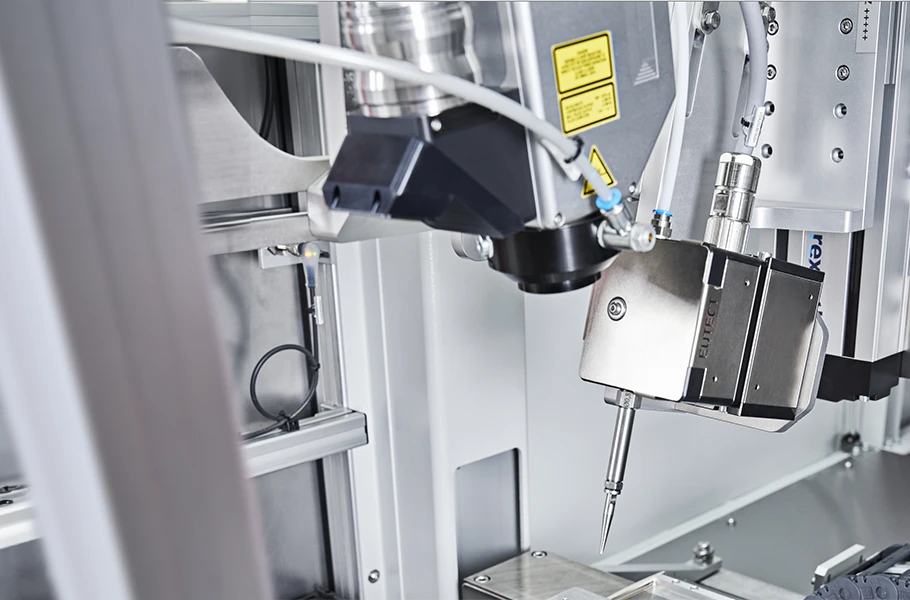
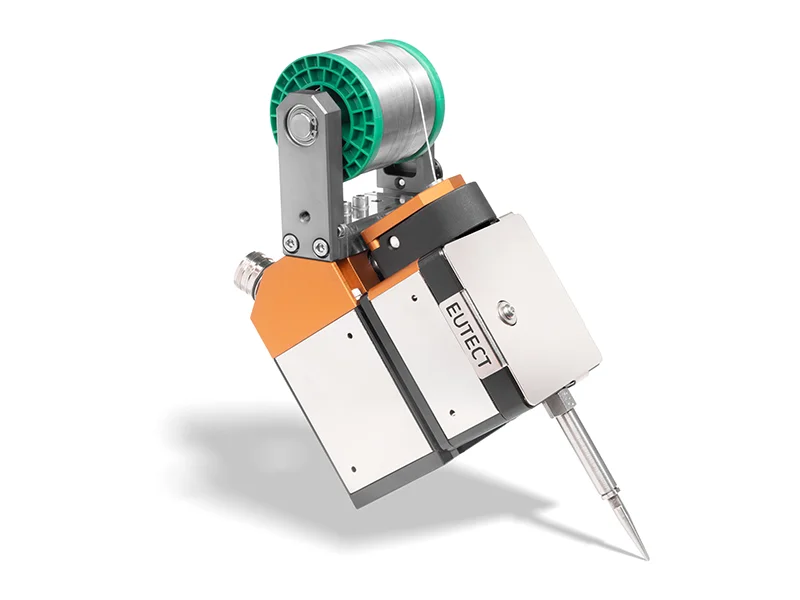
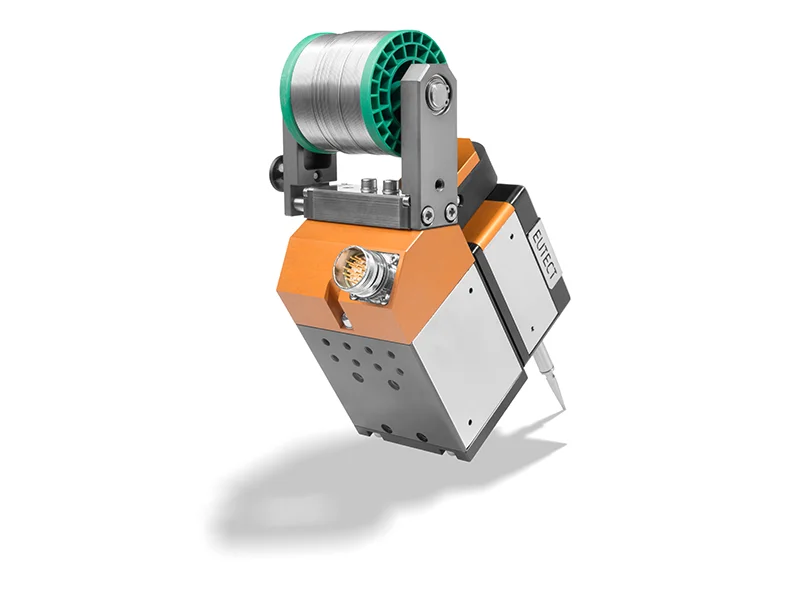
The SWF can be used for laser, piston and induction soldering and transports solder wires of different thicknesses. Thanks to the modular mechanics, it is possible to install the SWF at any point within a cell.
The SWF is suitable for various soldering processes, such as laser, induction and piston soldering. Thanks to its precise and controlled wire feed, it fulfils the requirements of demanding soldering processes and helps users to achieve reproducible soldering results.
A key feature of the SWF is its ability to measure the force with which the wire hits the solder joint. This precise and definable force detection means that tolerances in the working height can be easily compensated for. In addition, the system reliably recognizes errors such as incorrectly positioned wire or deviations, thus ensuring error-free processing.
With this system, companies can optimize their production processes and increase efficiency while maintaining the highest quality standards. The Sensitive Wire Feeder from EUTECT is the ideal solution for anyone who wants to take their soldering processes to the next level.
The Sensitive Wire Feeder (SWF) EUTECT’s system is a patented, force- and travel-controlled wire feed mechanism. The system guides the solder wire in a controlled manner to the solder joint whilst monitoring the wire feed. This enables deviations, such as a wire that has veered off course or is not being fed correctly, to be detected.
The SWF uses electromechanical sensors to detect the movement of the wire and the forces acting on it during feeding. By monitoring changes in the wire contact force, the system can detect when the solder wire reaches the process surface and the soldering process begins. This makes wire feeding a monitored part of the soldering process.
In the case of a force- and speed-controlled wire feed Both the distance travelled by the wire and the forces acting on it during feeding are taken into account. This enables the system to detect whether the wire reaches the intended position or, for example, deviates from it. At the same time, tolerances in the working height can be compensated for.
Thanks to its force and displacement monitoring, the Sensitive Wire Feeder Among other things, it can detect when a wire is incorrectly positioned, veers off course or fails to reach the intended process surface as expected. This enables deviations to be detected directly during the soldering process.
The SWF It can be used, amongst other things, for laser brazing, induction brazing and piston brazing. The system is particularly well suited to automated and selective brazing processes where reproducible wire feed and a high degree of process reliability are required.
At the Laser soldering The guide wire, component and laser energy must interact precisely. A controlled wire feed It enables the controlled and reproducible feeding of the brazing wire and can detect deviations during feeding. This helps to improve the process reliability of automated laser brazing processes.
The SWF can accommodate tolerances in the working height thanks to its force and travel control. The system uses the wire contact force to detect when the wire reaches the process surface. This means that the actual contact position does not have to result solely from a specified geometric position.
Yes. The process data for the wire feed can be recorded and assigned to a solder joint. In this way, the SWF It provides full traceability of individual selective solder joints and is particularly suitable for applications with high standards of process documentation and quality assurance.
The SWF monitors the wire feed directly during the process. This enables deviations in position, travel or force to be detected. Rather than simply transporting the solder wire, its feed thus becomes a monitored process step.
Due to the controlled and reproducible wire feed The amount of solder required can be precisely adjusted to suit the specific process. This helps to avoid the unnecessary feeding of solder wire and reduces solder consumption.
The SWF with MicroForceControl (MFC) is a version of the Sensitive Wire Feeder designed for particularly demanding micro-soldering processes. The technology enables even more sensitive force detection, thereby allowing the controlled feeding of very fine solder wires.
The SWF with MicroForceControl It was developed for very fine wires and micro-soldering applications. Solder wires with diameters of 0.1 mm and below can be fed in a controlled manner. This makes the technology particularly suitable for miniaturised components, small solder pads and high-density assemblies.
The sensitive force measurement system detects even very small forces when the wire comes into contact with the process surface. This allows the feed to be controlled before the thin wire is mechanically overloaded, deflects sideways or kinks.
The SWF with MicroForceControl It is particularly suitable for micro-soldering processes, miniaturised electronic assemblies, very small solder pads, complex geometries and applications involving extremely thin solder wires. It is therefore of particular interest for manufacturing processes in which conventional wire-feeding systems reach their mechanical or sensory limits.
Yes. Thanks to its modular design, the SWF can be integrated into various production and automation concepts. It is therefore suitable both for new soldering systems and, depending on the technical requirements, for integration into existing production cells.