Enamelled copper wire soldering

Clean and reliable stripping and tinning of enamelled copper wires
Enamelled copper wire technology is a core process in the production of current and future mobility requirements.

Benefit

With conventional soldering technology, enamelled copper wires coated with polyurethane or polyesterimide cannot be processed without oxide formation and insulation residues on the wire and in the soldering module. The mini wave soldering module from EUTECT prevents this without any loss of service life.

Applications

Today's e-mobility concepts require a large number of switching and transformation components, coilformers, magnetic heads, sensors, relays and other electronic components that also require enamelled copper wire technology for their production. Enamelled wire manufacturers are constantly developing new products to meet these diverse requirements. These are provided with a wide variety of insulation materials, some of which are also newly developed, in order to improve the insulation class and thermal resistance for future end products.

What is enamelled copper wire, and why does it place particular demands on the soldering process?

Enamelled copper wire consists of a copper conductor coated with a thin insulating layer of special enamels. It is used, amongst other things, in electric motors, transformers, coils and power electronics. Before soldering, this enamel coating must be reliably removed without damaging the conductor.

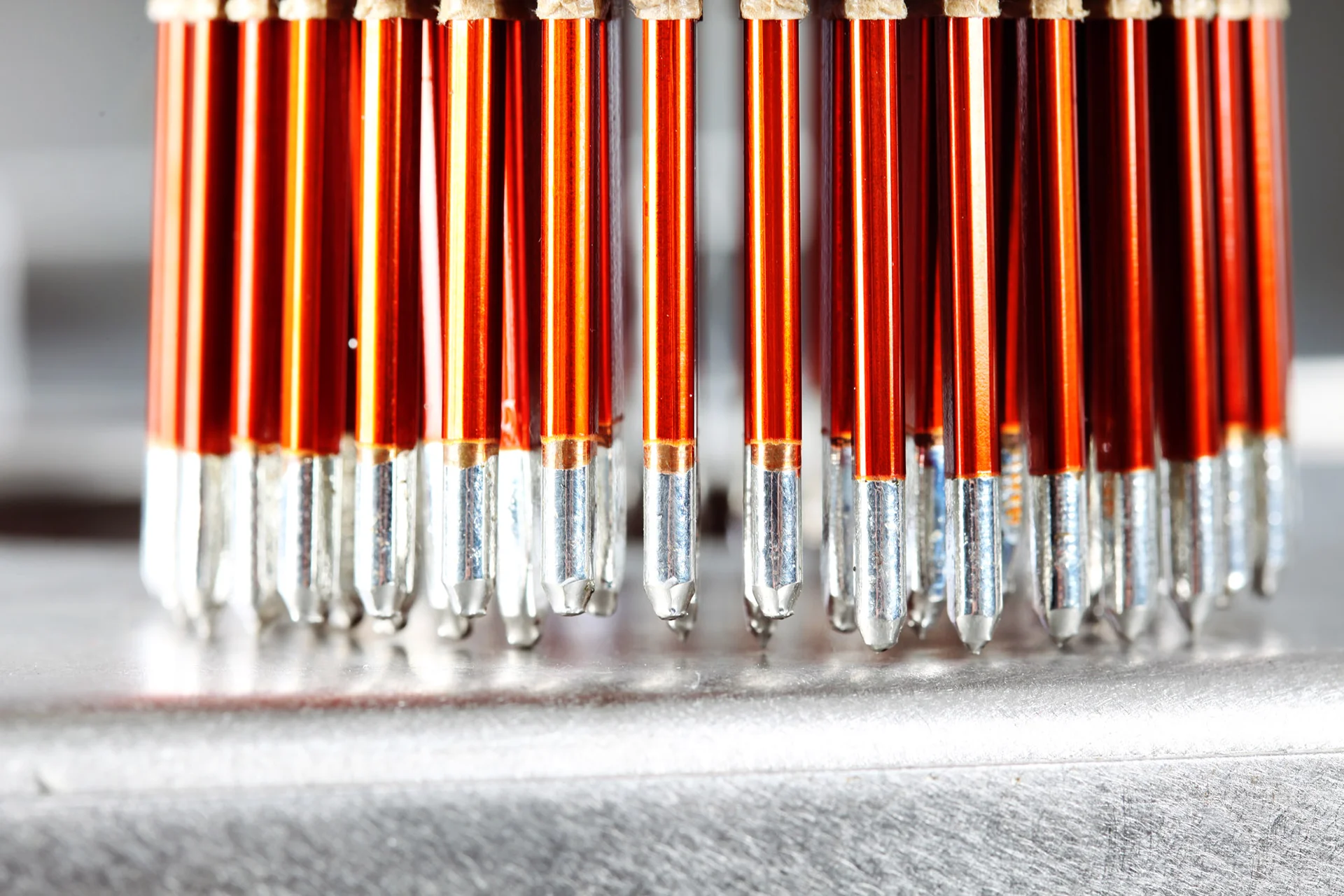
Thermal stripping of enamelled copper wire enables the insulation to be removed and the wire to be tinned in a single process step. This allows enamelled copper wire to be processed efficiently and prepared for a secure electrical connection. This technology is becoming increasingly important, particularly in automated manufacturing processes.

Performance

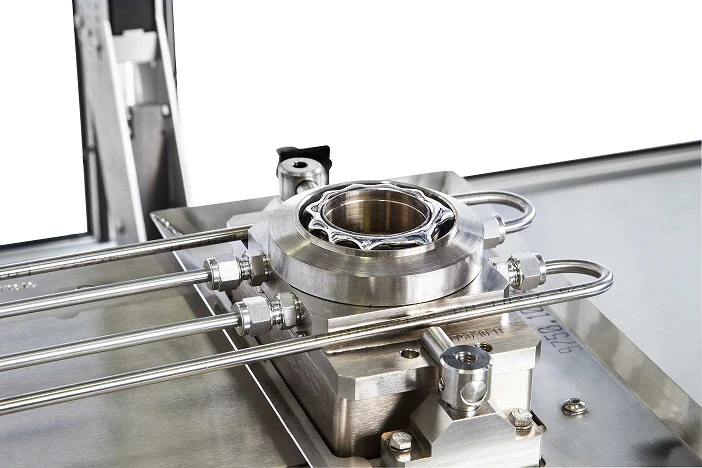
EUTECT's modular system includes selective soldering processes that allow coated enamelled copper wires to be stripped and tinned thermally and reliably in a single step without additional removal of the insulation. Lead-free processing with all its characteristic process finesse in relation to the specific solder alloy, the flux and the temperature-time curve with flowing molten solder is the overarching core expertise of target-oriented process processing. EUTECT has developed soldering systems that reach temperatures of up to 475 °C. These systems work with a flowing solder wave that reliably removes any remaining insulation residue from the tinning point. Complete nitrogen gassing of the solder wave also ensures permanent oxide-free tinning.

Product highlights

  • Flowing molten solder for tinning without insulation residue
  • Gentle and product-specific stripping of wire insulation
  • Process-safe tinning of copper wires
  • Horizontally installed induction pump prevents direct deposition of solder residue in the induction pump.
  • Minimal solder oxide formation
  • Protection through appropriate masking options
  • Avoidance of black dots

Challenges involved in soldering enamelled copper wire

When soldering enamelled copper wire, the insulating enamel coating must be completely removed to ensure that the solder wets the surface properly. Even the smallest traces of enamel residue can compromise the quality of the joint and lead to failures in the long term.

In addition, modern high-temperature enamels and increasing demands on cycle times and process reliability pose challenges for manufacturing. Particularly when it comes to the selective soldering of enamelled wires, winding terminals or coil terminals, reproducible processes are crucial for ensuring consistently reliable enamelled copper wire bonding.

Soldering enamelled copper wire for hairpin motors and e-mobility

In the field of electromobility, hairpin stators are increasingly being used to achieve higher power densities and efficiency levels. Soldering enamelled copper wire plays a key role in this, as the individual conductor ends must be reliably stripped of their enamel coating, tinned and joined. EUTECT process technology enables this to be carried out in a single automated step.

This automated process enables reproducible manufacturing on a large scale and supports manufacturers in the production of traction motors, generators and other electric drive systems. This makes EUTECT enamelled copper wire soldering an important component of modern e-mobility manufacturing.

Limitations of mechanical and chemical paint-stripping processes

Mechanical and chemical methods for stripping the insulation from enamelled copper wire involve additional process steps and increase the workload in production. At the same time, tool wear, damage to the conductor or the use of chemicals can compromise cost-effectiveness and process reliability.

In thermal stripping, the enamelled copper wire is stripped of its enamel and tinned in a single process step within the EUTECT module. This reduces process times, improves reproducibility and efficiently meets the requirements of modern mass production.

Inert gas and process control in the soldering of enamelled copper wire

Inert gas atmospheres reduce oxidation during the paint stripping and tinning process and improve the quality of the solder joint. At the same time, precise process control ensures that the temperature, dwell time and energy input are optimally tailored to the specific enamelled copper wire.

The continuous monitoring of all relevant process parameters by the EUTECT process monitoring system enhances process reliability and supports comprehensive quality documentation. This enables even the most demanding applications in electric mobility, power electronics and aerospace to be implemented reliably.

FAQs

At the Enamelled copper wire soldering Enamel-insulated copper wires are prepared for electrical connection and tinned. Using a suitable soldering process, the enamel insulation can be thermally removed and the exposed copper conductor tinned directly. This allows the removal of the enamel and the tinning to be carried out in a single process step.

Enamelled copper wires Depending on the insulation material, the insulation can be stripped mechanically, chemically or thermally. With the soldering technology used by EUTECT, the insulation is removed thermally using the molten solder. The insulation is removed during the soldering process and the copper wire is tinned at the same time.

Yes. With appropriately designed selective soldering process Coated enamelled copper wires can be thermally stripped and tin-plated immediately afterwards. This eliminates the need for an additional upstream process to remove the insulation. EUTECT

Workability depends on the specific paint or insulation system and its thermal properties. These include, for example, Enamelled copper wires with polyurethane or polyesterimide coatings. Process parameters and soldering techniques must be tailored to the specific wire and its insulation class.

The required temperature depends in particular on Wire, insulation material and solder alloy. The systems developed by EUTECT for these applications can withstand process temperatures of up to 475 °C. In addition to temperature, the solder alloy, flux and temperature-time profile are also crucial process parameters.

The flowing molten solder aids both the thermal paint-stripping process and the subsequent tin plating. Any remaining insulation residues can be removed from the tin-plating area. This helps to ensure a clean and reproducible contact surface.

Will Paint stripping and tin plating By combining these steps into a single process, an additional processing stage can be eliminated. This reduces the number of process stations and simplifies integration into automated manufacturing systems. At the same time, the process can be tailored to specific products in terms of wire, insulation and the required tin plating.

Nitrogen flushing reduces oxygen contact with the hot solder melt. This minimises the formation of oxides during the soldering and tinning process. EUTECT employs full nitrogen flushing of the solder wave to ensure consistently low-oxidation or oxidation-free tin plating.

The key factor in Enamelled copper wire soldering These include, amongst others, wire diameter, coating and insulation system, solder alloy, flux, soldering temperature, contact time or temperature-time profile, and the movement of the molten solder. These parameters must be tailored to the specific product and the required tin-plating quality.

To achieve this, the temperature, process time and flow behaviour of the molten solder must be tailored to the specific insulating material in such a way that the varnish layer is reliably removed. With EUTECT technology, the flowing wave of molten solder helps to carry away any remaining insulation residues from the tinning area.

The procedure It is suitable, amongst other things, for coils, transformers, magnetic heads, sensors, relays and other electrical and electronic assemblies containing varnish-insulated copper wires. The technology is of particular importance, for example, for applications in electromobility.

Yes. Electric drives and power electronics require numerous coil, transformer, sensor and connection solutions featuring varnish-insulated copper conductors. At the same time, the requirements for insulation classes and thermal resistance are increasing, which means that controlled and reproducible Paint stripping and tinning processes are becoming increasingly important.

Black dots may occur in connection with residues and thermal or oxidative effects during the processing of enamel-insulated wires. A controlled process involving carefully regulated temperature control, a continuously moving molten solder stream and reduced oxidation helps to prevent such contamination at the tinning point. EUTECT expressly identifies the prevention of black dots as one of the product features of the Soldering enamelled copper wire ... is called.

Yes. Selective soldering modules can, in principle, be integrated into automated production lines and adapted to component geometry, wire position and the required process sequence. This makes the Procedure both for specialised soldering tasks and for automated mass production processes.

Yes. EUTECT describes that Procedure specifically for lead-free soldering. The key factor here is a combination of solder alloy, flux, temperature and process time that is tailored to the specific application.