
Thermode soldering / Bar soldering

Process-safe thermode/iron soldering
EUTECT thermode soldering or bar soldering is the only system in the world with a definable and µ-precise penetration path Because of that thermode soldering in electronics production is an ideal solution for high process reliability.

Benefit

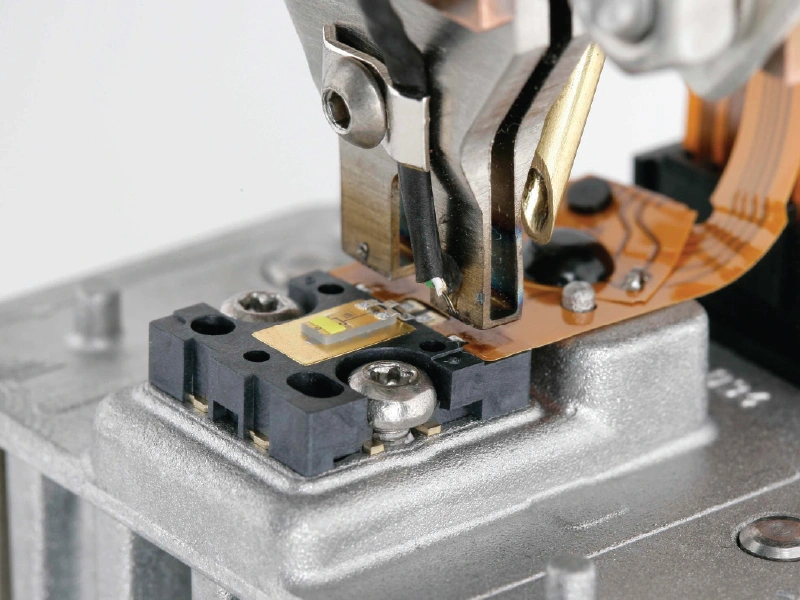
The thermode soldering process enables you to process flexible foils, cable strands and ribbon cables as well as specific SMD components. You achieve high quality results and reproducibility in the soldering process.

Performance

Force, resetting distance and temperature are controlled, visualised and recorded via an HMI control unit. This gives your overall process performance the best possible availability and traceability.

Modularity

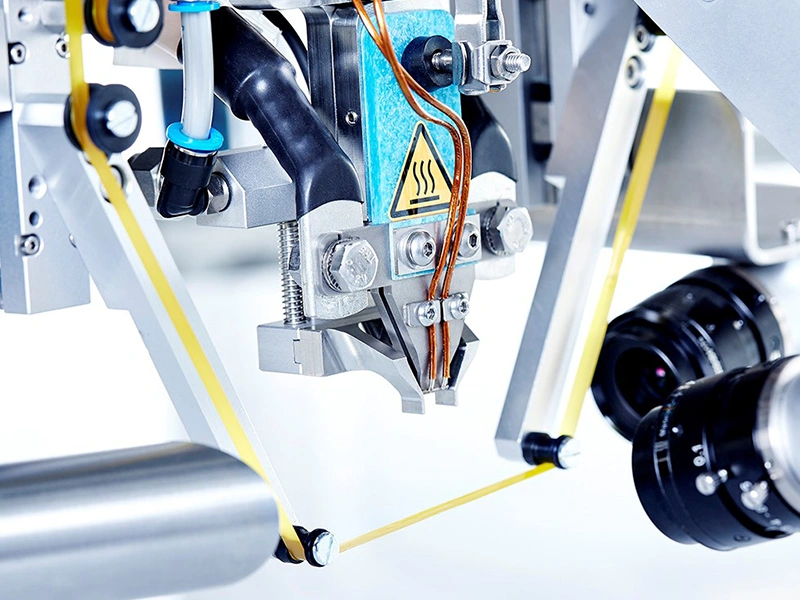
You can integrate the modular thermode soldering system into stand-alone or inline processes. The application-specific thermode geometries are protected by automatic capton feeders and keep your process stable.

Advantages of thermode soldering

A major advantage of this soldering process is the high process stability and exact repeatability, which is for example crucial for wire harness soldering. Thanks to the precise control of temperature, penetration path and contact pressure, it is possible to produce solder joints of consistent quality and reduce rejects. Thanks to its modular design, this soldering process can be flexibly adapted to different production requirements and integrated either as a stand-alone solution or in automated production lines.

Product highlights

  • High energy efficiency
  • Temperature-force-displacement control
  • µ-precise sinking distance
  • Freely definable energy input
  • Redundant temperature measurement
  • 100% traceability
  • Cycle time optimisation of up to 70%
  • Short set-up times
  • Minimized solder consumption
  • Low maintenance effort
  • Specific thermode geometries
  • Thermode feed through intelligent linear axes
  • Contact pressure is displayed in steps of 0.5 N
  • Integrated Kapton belt module
  • Rapid heat input
  • Fast, integrated thermode cooling
  • Leading and trailing hold-down device
  • Maximum service life
  • Minimal footprint
  • Immediate system and process availability

Basics of thermode and bar soldering

Thermode and bar soldering is based on the principle of heat application using a heating tip (thermode), which is placed precisely on the materials to be soldered. The direct contact between the heating tip and the soldering material allows the necessary heat to be applied to melt the solder. The main difference to other soldering processes is that only specific areas can be heated. This is particularly important if neighbouring components or areas are to remain unaffected by the heating.
Environmental and cost benefits

In addition to the technical advantages, thermode and bar soldering also offers ecological and economic benefits. The precise use of heat and solder minimises material consumption and ensures high energy efficiency. In addition, the set-up times for changing over to different components and soldering tasks are extremely short, which increases production flexibility and reduces costs.

As EUTECT's systems have a modular design, they can be easily integrated into existing production systems and adapted to new requirements.

Precise control and process monitoring

A key feature of EUTECT thermode and iron soldering is the ability to precisely monitor and control the entire process. EUTECT systems offer comprehensive control options for the temperature, contact pressure and penetration path of the soldering tools. As the entire soldering process therefore takes place under perfect conditions, mechanically stable and electrically reliable connections are created.

In addition, all relevant process parameters can be recorded and documented in real time. This is particularly important when complete traceability of the manufacturing steps is required. For example, in the automotive or medical technology industries. Thanks to this comprehensive process monitoring, sources of error can be quickly recognised and rectified, further increasing production reliability.

Product video

FAQs

thermode soldering is a selective soldering process in which the required heat is transferred directly to the solder joint via a heated tool, known as a thermode. In this process, the components to be joined are positioned precisely and heated locally until the solder melts. Reproducible solder joints can be produced through the precise control of temperature, force and travel.

Soldering with a soldering iron is a term for the thermode soldering. In this process, a heated thermode is placed on the components to be joined, and the heat is transferred through direct contact. The process is particularly suitable for soldering tasks where several contact points are to be soldered simultaneously or where defined areas are to be soldered in a reproducible manner.

thermode soldering It is particularly suitable for soldering flexible films, ribbon cables, stranded wires and certain SMD components. Typical applications include any situation where precise localised heat application, defined contact pressures and a high degree of repeatability are required.

Among the key benefits of the Thermal brazing These include high process stability and reproducibility, as well as precise control of the soldering process. Temperature, force and travel can be monitored and documented. This ensures consistent quality of the soldered joints whilst reducing the risk of rejects.

Among the most important process parameters of the Thermal brazing These include temperature, contact pressure, penetration or settlement distance, and process time. The interaction of these parameters influences the heat input, the melting of the solder, and the mechanical and electrical quality of the solder joint. At EUTECT, these parameters are controlled, visualised and recorded.

The sink-in or follow-through stroke describes the movement of the soldering tip during the soldering process. A precisely defined stroke allows for controlled alignment of the materials to be joined whilst the solder is melting. The EUTECT Thermal Soldering System This allows the deflection to be defined with µ-level precision.

The quality of the process in the thermode soldering can be monitored by continuously recording relevant parameters such as temperature, force and displacement. This enables deviations from the defined process window to be detected and process data to be documented. This supports reproducible production and the traceability of soldering processes.

Yes. With suitably equipped EUTECT systems, the relevant process parameters can be monitored during the thermode soldering recorded and documented. This makes it possible to trace the soldering process for an assembly or a soldered joint. This is particularly relevant for applications with high quality and documentation requirements.

thermode soldering enables a locally confined and controlled heat input. This allows areas outside the actual solder joint to be protected from heat. However, whether the process is suitable for a particular sensitive component depends on its material, geometry, temperature resistance and the specific soldering task.

Kapton tape can be used as a protective and separating layer between the thermod and the component. It helps to ensure a stable process and protects application-specific thermod geometries. EUTECT can provide an automatic Kapton feed into the Thermode soldering module integrate.

The geometry of the thermode is tailored to the specific soldering task and component geometry. Consequently, different products may require different Thermal geometries may be required. The application-specific design enables targeted and reproducible heat input.

At the thermode soldering The thermode provides both mechanical contact and heat transfer. In the EUTECT Laser Knife The components to be soldered are brought together in a controlled manner by a hold-down mechanism that monitors force and travel, whilst heat is applied contactlessly by a laser. Depending on the application, this can result in significantly shorter process times.

Yes. Thermal soldering modules can be integrated into automated manufacturing systems. EUTECT can implement the process both as a stand-alone solution and within an automated in-line system. This enables the thermode soldering can be combined with further process, handling and testing steps.

In principle, yes. Thanks to the system’s modular design, it is possible to Thermal soldering modules can be adapted to different automation and production concepts. The specific integration depends on component handling, cycle time, available installation space, interfaces, and upstream and downstream manufacturing steps.

A stable process window is an essential prerequisite. By controlling and monitoring the combination of temperature, force and displacement, deviations can be reduced and soldering processes carried out in a reproducible manner. Furthermore, the process data recorded enables targeted analysis and optimisation of the manufacturing process.

thermode soldering It is particularly suitable for industrial applications with high demands in terms of precision, reproducibility and process documentation. These may include, for example, applications in automotive engineering, medical technology, industrial electronics and other areas of high-precision electronics manufacturing.

Suitability for the  thermode soldering depends, amongst other things, on materials, component geometry, solder joints, accessibility, temperature limits, the required contact pressure, quality requirements and the desired cycle time. An evaluation carried out at EUTECT using actual components can help to determine the suitable soldering process and the necessary process parameters for the specific application.

Kontakt

Inhaltsverzeichnis