
The role of the solder mask in mini-wave soldering
In mini-wave soldering, a small, precisely guided wave of solder is used to selectively wet specific solder joints on a printed circuit board. The solder mask plays a crucial role in controlling this process.
The solder mask defines the exact contact area between the solder and the assembly. This ensures that the liquid solder adheres only to the intended solder joints. At the same time, adjacent components such as connectors, housing areas or sensitive components are effectively shielded.
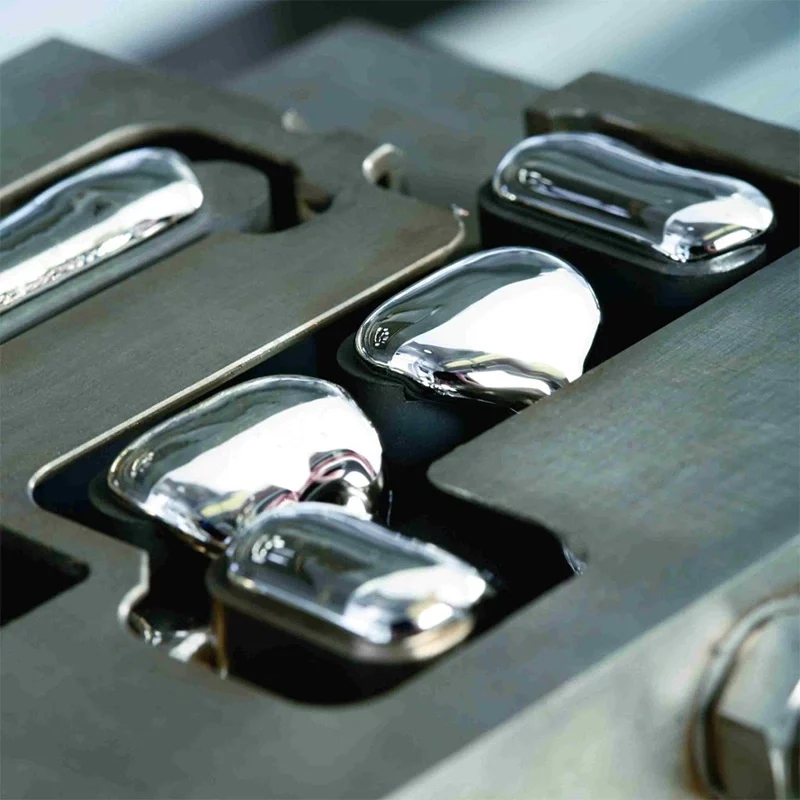
Thanks to precision manufacturing and many years of process experience, it is possible to produce complex titanium mask geometries with very thin wall thicknesses, thereby enabling controlled solder flow whilst ensuring optimum accessibility to the solder joints. This precision is a crucial factor for stable and reproducible soldering processes, particularly in high-density assemblies.
Advantages of titanium as a material in the soldering process
The use of titanium as a mask material offers several technical advantages, which are particularly evident in micro-wave soldering.
Titanium is characterised by high thermal stability, low thermal conductivity and very high mechanical strength. This combination is particularly important in the context of repeated thermal cycles, such as those commonly encountered in selective soldering processes.
Another advantage is the material’s low thermal expansion. The geometry of the titanium solder mask retains its shape even after many soldering cycles. The material’s dimensional stability ensures that the defined solder contact area is maintained over the long term and that the process remains reproducible.
Compared with conventional masks made of stainless steel or plastic, titanium therefore makes a significant contribution to consistently high process quality and long-term stability in mass production.
Heat-treated titanium solder masks and their surface properties
One factor affecting quality is the surface of the solder mask. Heat-treated titanium solder masks have a particularly uniform surface that repels solder.
This surface structure prevents unwanted solder adhesion to the mask whilst also reducing heat sinks in the process, thereby ensuring an even temperature distribution during the soldering process.
Furthermore, the solder-repellent surface helps to ensure that solder flows cleanly along the mask geometry. This significantly reduces solder bridges or uncontrolled wetting, which in turn improves process reliability.
Thermal decoupling of sensitive component areas
As well as simply guiding the process, the titanium solder mask also performs an important protective function within the assembly.
Due to its low thermal conductivity, titanium acts as a thermal barrier between the active soldering area and adjacent components. Components with limited temperature resistance benefit particularly from this property.
These include, for example:
- Plastic housings
- Sensors
- Connectors
- Sensitive electronic components
The mask geometry enables both targeted wetting of the solder joints and controlled solder flow. This allows thermally critical assemblies to be soldered reliably and reproducibly.
Significance for industrial electronics manufacturing
In industrial applications, titanium solder masks play a key role in ensuring the stability and efficiency of mini-wave soldering.
Thanks to their high dimensional stability, precise geometry and thermal properties, they enable reproducible process control over many soldering cycles. At the same time, components are reliably protected and errors in the soldering process are reduced.
These characteristics are particularly relevant in sectors with high quality standards, such as:
- Aviation industry
- Medical industry
- Automotive industry
Particularly in the case of high-density and thermally sensitive assemblies, titanium solder masks play a crucial role in ensuring reliable and cost-effective mass production.
For technical decision-makers in electronics manufacturing, the use of titanium solder masks offers clear advantages. These include greater process reliability, reproducible soldering quality and cost-effective mass production, even for complex and thermally sensitive assemblies.