Induction coil geometry influences heat distribution during induction soldering
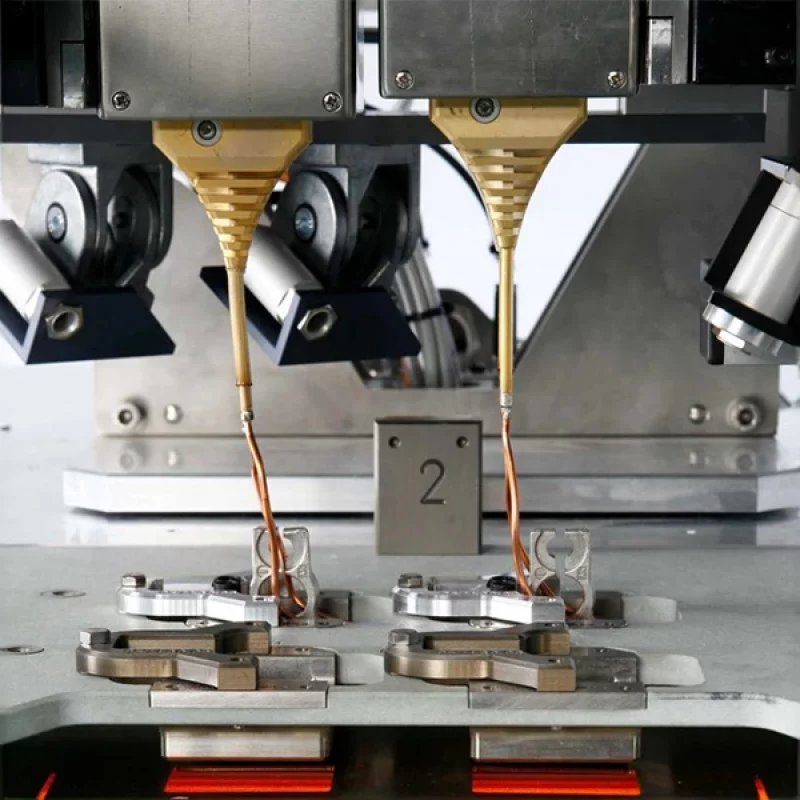
The geometry of the induction coil is one of the most important factors in induction soldering. It determines how the electromagnetic field is generated and where the heat is produced within the workpiece. In electronics manufacturing in particular, it is often necessary to heat very small and specific areas without subjecting adjacent components to thermal stress.
Key factors here include the number of turns, the pitch, the coil diameter and the precise positioning relative to the solder joint. The distance between the coil and the workpiece also has a direct impact on energy input and, consequently, on process stability.
As every assembly has different requirements, EUTECT develops induction coils for induction soldering that are individually tailored to the specific component geometry and application.
Here you will find further information on EUTECT induction soldering:
The right frequency is crucial for induction soldering
In addition to the geometry, the frequency of the generator plays a key role. It influences the penetration depth of the induced currents into the material and thus the type of heating. High frequencies tend to heat the surface, whilst lower frequencies penetrate deeper into the material.
Correct frequency tuning is crucial, particularly when dealing with fine contacts, small metal structures or sensitive electronic components. The aim is to apply the required heat precisely to the solder joint without subjecting the surrounding areas to unnecessary thermal stress.
To ensure a stable process, the frequency, material properties and thermal mass of the assembly must be precisely matched.
Material properties influence behaviour during induction soldering
The behaviour of an assembly in an electromagnetic field depends heavily on the materials used. Different materials react very differently to inductive heating, which is why material selection must be taken into account as early as the process development stage.
Key factors include:
- electrical conductivity
- magnetic permeability
- thermal conductivity
- material thickness
- surface finish
Particularly in electronics manufacturing, where different materials are often combined within a single assembly, this coordination is a key part of the development of an induction coil for induction soldering.
Precisely control the thermal behaviour of the assembly
When it comes to induction soldering, it is not enough to consider just the actual solder joint. The entire thermal environment of the assembly also influences the process. Heat dissipation via printed circuit boards, heat sinks or solid mating parts can significantly alter the temperature profile.
In addition, temperature-sensitive components must be protected. The aim is therefore to limit heat input to as small an area as possible whilst maintaining controlled temperature regulation.
Particularly in the case of sophisticated electronic assemblies, this precise thermal control is crucial for ensuring both process reliability and component protection.
Induction coil for stable processes and short cycle times
In industrial manufacturing environments, short process times and stable production runs are of paramount importance. An induction coil for induction soldering must therefore be designed in such a way that short heating times can be achieved without compromising process control.
At the same time, it is essential to ensure reproducible temperature profiles and consistent results over many cycles. The key lies in striking a balance between rapid energy input and controlled heating.
Only when this interplay works can processes be implemented that are both efficient and stable.
Cooling and temperature management of the induction coil
Induction coils themselves are subjected to high thermal stresses. These can affect the following parameters:
- process stability
- service life of the coil
- long-term reproducibility
Stable temperature control of the coil is essential, particularly in highly dynamic production processes.
EMC, automation and integration into production lines
In electronics manufacturing, an induction coil must not only function correctly from a thermal and electrical point of view, but must also integrate seamlessly into automated systems.
Electromagnetic compatibility, accessibility of solder joints and integration into robotic and axis systems all play a key role in this regard. At the same time, maintenance and replacement strategies must be taken into account in order to minimise production downtime.
EUTECT takes these aspects into account right from the early stages of development to ensure that the systems can be reliably integrated into existing production lines.
Here you will find further information about our evaluation processes:
Control technology improves process reliability in induction soldering
Modern induction soldering processes increasingly utilise closed-loop control systems. Temperature measurement, power control and real-time monitoring enable precise control of the energy input.
This allows for fluctuations in the material or the environment to be compensated for, thereby ensuring a high level of process reliability. Particularly in demanding applications within medical technology, automotive electronics or power electronics, this control technology is an essential component of EUTECT’s coil and process development.
Induction coil and induction soldering as an integrated system
In assembly and joining technology, universal standard solutions are rare. Instead, modern processes require custom-designed systems in which the induction coil, generator, control technology and process control are precisely coordinated.
This is precisely where the strength of specialist equipment manufacturers such as EUTECT lies, as the combination of application expertise, process development and customised coil design enables highly precise and reproducible soldering processes for modern electronic assemblies.
Induction coil as a key component for precise induction soldering
The induction coil is one of the most important components in induction soldering. It has a direct influence on heat distribution, process stability and the reproducibility of the entire soldering process.
Only when geometry, frequency, material properties, thermal management and control technology work together optimally can stable and cost-effective processes be achieved. EUTECT therefore develops bespoke solutions that are precisely tailored to the requirements of modern electronics manufacturing.