
Efficiency gains through integrated processes in production cells
A key advantage of a production cell is the reduction in interfaces. As all process steps take place within a single system, there is no need for unnecessary handover procedures or transport routes.
In practice, this leads to:
- significantly reduced throughput times
- minimised set-up times
- fewer material movements and interim storage operations
At the same time, the available space is used more efficiently, as several processes are combined into a single compact unit. This is a key advantage, particularly in production environments where space is limited.
Greater process control and improved quality through production cells
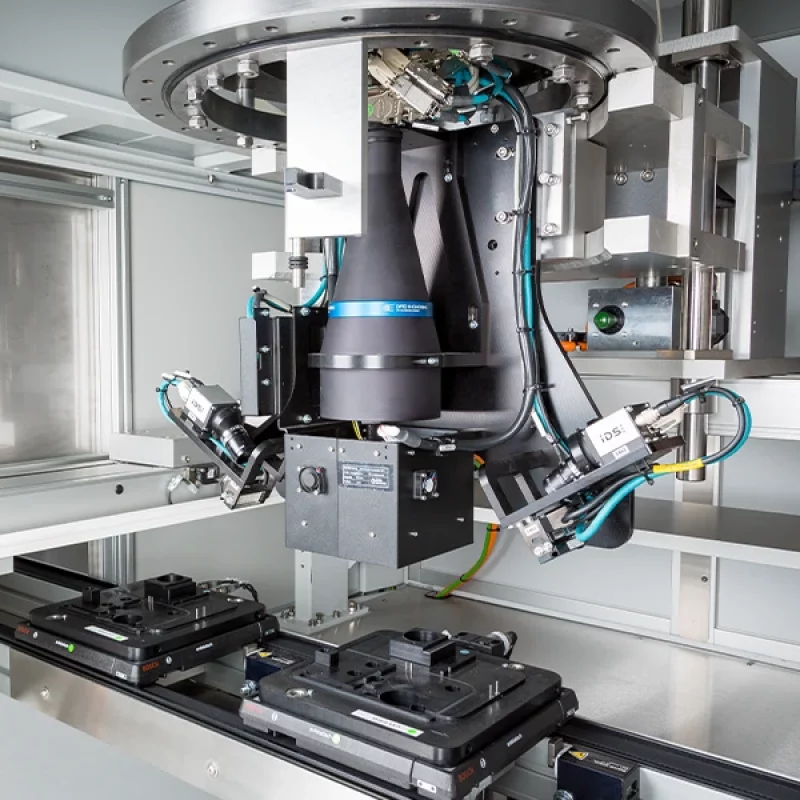
Integrating all manufacturing steps into a single production cell enables end-to-end process monitoring. All relevant parameters can be recorded and controlled centrally.
This enables significantly improved process control, in particular through:
- real-time monitoring of all process steps
- rapid identification of discrepancies
- real-time correction whilst the system is running
This transparency improves reproducibility and has a direct impact on the quality of the assemblies. Errors are detected at an early stage, thereby reducing scrap and rework.
Flexibility through automation and scalability
Modern production cells are not only efficient, but also flexible. The use of digital control systems allows processes to be adapted quickly.
Companies benefit from:
- easy adaptation to new product requirements
- flexible scaling as production volumes increase
- integration of additional process steps
This flexibility makes it possible to respond quickly to changes in the market and to adjust production capacity as required.
Economic benefits of production cells in mass production
Combining several processes within a production cell has a direct impact on the cost structure. Optimised processes lead to a more efficient use of resources.
Typical economic effects include:
- lower staff costs
- reduced downtime
- optimised use of plant and equipment
- lower energy consumption
As unnecessary movements and process interruptions are eliminated, overall plant efficiency increases significantly.
Modular production cells featuring EUTECT’s E-Cell
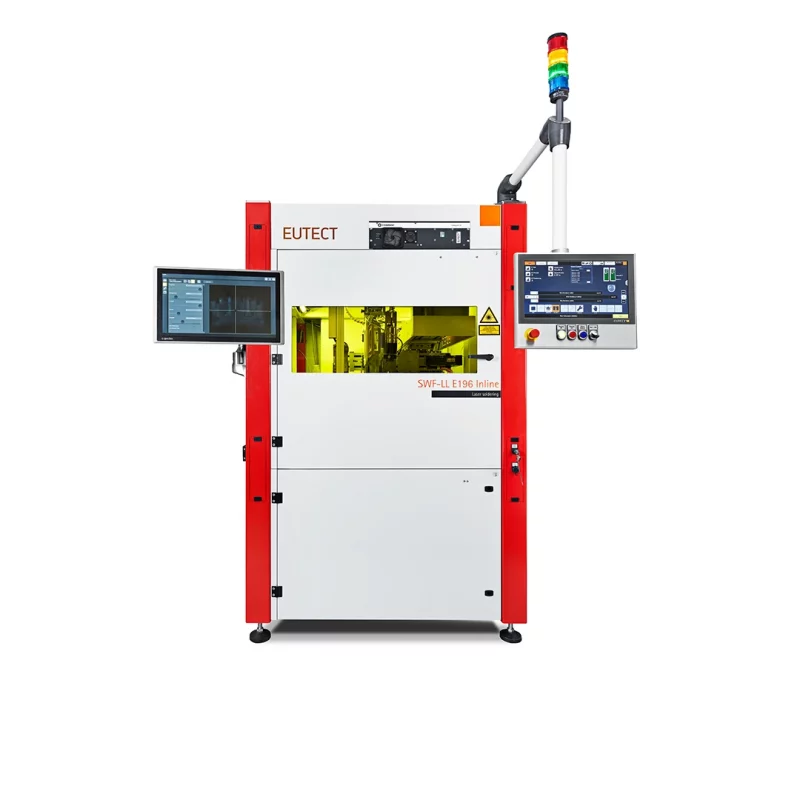
To meet these requirements, EUTECT has developed the E-Cell. This modular production cell is specifically designed to combine several manufacturing steps within a single compact unit.
Measuring approximately 2.25 by 3.15 metres, it offers sufficient space for various process modules whilst also allowing for efficient use of space.
Thanks to its modular design, the E-Cell can be flexibly adapted to a range of applications, thereby supporting a future-proof production strategy.
Competitive advantage through integrated production cells
Combining manufacturing processes within a single production cell offers clear advantages in terms of efficiency, quality and cost. The close integration of the individual steps results in stable and reproducible processes that can be flexibly adapted to new requirements.
Companies benefit from improved resource utilisation, lower operating costs and greater competitiveness in electronics manufacturing.
Find out more about how the individual production stages are interlinked: