Why is optimising the selective soldering process so important?
In applications such as railway technology or in the green energy sector, electronic assemblies must function reliably for decades. The requirements regarding solder joint quality and process reliability are correspondingly high.
An optimised selective soldering process helps to:
- to ensure the long-term quality of soldered joints
- to manufacture safety-critical components reliably
- to ensure the long-term stability of the products
Modern soldering process technology and automation are therefore indispensable in these areas.
Improving process reliability in selective soldering through modern control technology
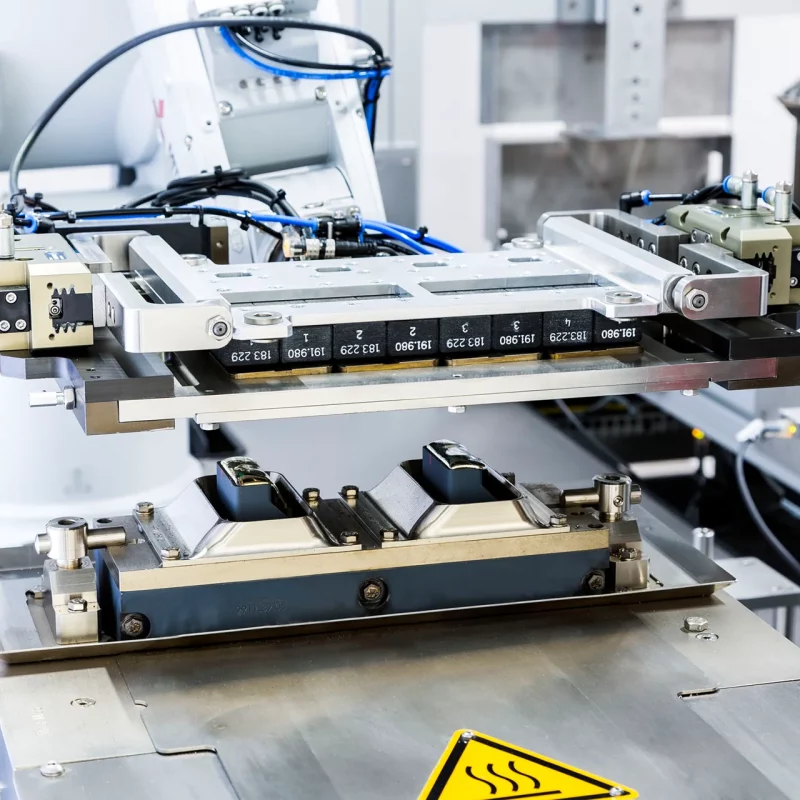
Control technology is a key component of process optimisation. It ensures that all relevant parameters are precisely controlled and monitored.
EUTECT offers solutions that:
- ensure a high level of process reliability
- record detailed process data
- enable full traceability
In addition, each system is custom-designed to achieve maximum precision and efficiency for the specific application.
Increasing production speed in the selective soldering process through automation
Another key advantage is the increase in production speed. Automated systems operate significantly faster than manual or semi-automated systems.
This is particularly evident in shorter process times, continuous and stable operations, and higher output, regardless of the soldering process used. This increase in efficiency has a direct impact on the productivity of the entire manufacturing process.
Reducing costs through optimised processes in the selective soldering process
As well as quality, cost-effectiveness plays a crucial role. By optimising the selective soldering process, costs can be reduced in a targeted manner.
Key effects include:
- lower staff costs due to fewer manual interventions
- reduced scrap rates
- minimised downtime
EUTECT also enables a predictable and low total cost of ownership, thereby ensuring long-term cost-effectiveness.

Using modular system designs to create a flexible selective soldering process
A key advantage of modern soldering systems is their modular design. This allows companies to remain flexible and adapt their systems to changing requirements.
In practice, this means the ability to carry out a simple upgrade to existing systems, to adapt them to new components, and to ensure the investment can be used over the long term.
This flexibility is particularly important in dynamic markets with rapidly changing requirements.
Reproducible soldering processes ensure high-quality solder joints
Modern selective soldering processes are characterised by a high degree of stability and reproducibility. This is a crucial factor, particularly when producing large quantities.
Optimised systems ensure:
- consistent process conditions
- consistent solder joint quality
- reliable tin plating
This is particularly essential in sectors with high quality standards.
Optimising the selective soldering process for greater efficiency and competitiveness
Optimising the selective soldering process offers clear advantages in terms of quality, efficiency and cost. Processes can be improved in the long term through automation, modern control technology and modular plant designs.
EUTECT helps companies to future-proof their manufacturing processes whilst ensuring consistently high-quality solder joints.